
Identify a Kiowa County Owner
The shortest reliable answer comes from pairing two county records. The Kiowa County Appraiser supplies the assessment lead. The Kiowa County Register of Deeds supplies the recorded transfer behind it. The county publishes no open online parcel card or deed index, so expect to call, visit, fax, mail a request, or file a focused Kansas Open Records Act request. Start with the strongest identifier you have. Keep the date of every response.
- Give the Kiowa County Appraiser the full situs address, city, ZIP, and parcel number if known. Ask for the owner-of-record name, legal description, mailing address if public, and the record's effective date.
- Take the exact name and legal description to the Register of Deeds. Ask for the most recent vesting deed and its book/page or instrument locator.
- Compare grantee, legal description, and recording date. A grantee is the party receiving the interest. Resolve a mismatch before treating either name as current.
- If the deed names a company, use the Kansas business entity search to confirm its legal name and status. The entity result identifies the business, not its parcel ownership.
This flow finds ownership. It is not a title opinion. A current deed can still be affected by later court orders, liens, easements, or unrecorded issues, so buyers and sellers needing an insured conclusion should turn to a qualified title professional.
Kiowa County Owner Request Fields
Kiowa County's KDOR CAMA endpoint sits behind a gate. A User ID and password are required. It offers no open owner search, parcel card, result list, or update date. That gate marks an access limit, not proof the assessment fields are missing. A precise office request is the practical substitute.
| Identifier to give | Situs address, city and ZIP, parcel number with leading zeroes, or full legal description |
|---|---|
| Fields to request | Owner name, mailing address if public, situs, parcel number, land and improvement values, appraised and assessed values |
| Date question | Ask when the record became effective and whether a newer deed is pending update |
| Copy preference | State whether inspection, an ordinary copy, or a certified county record is needed |
The Appraiser does not publish the owner field's exact public label or the normal deed-to-roll lag. Record the wording the office uses rather than converting it into a stronger title claim. The official Appraiser page shows the county office and its valuation role.
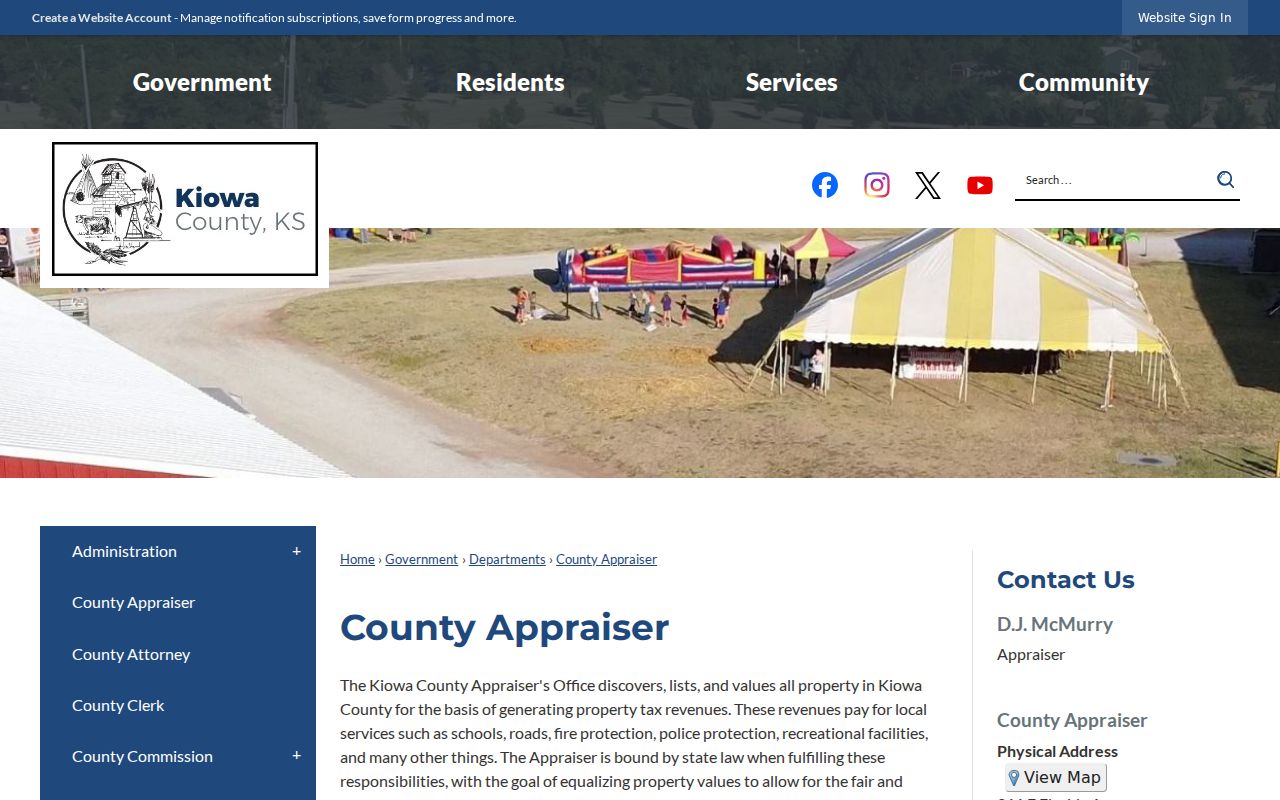
The county page confirms the office route. With no public parcel result online, a direct record request remains necessary.
Date the Kiowa County Owner Result
Ownership records answer questions as of a date. The Appraiser mails annual value notices in early March. The office also keeps current and prior-year valuation history. But that schedule does not show how fast a new deed changes the roll. A closing, a recording, and an assessment update can land on three different days. Ask for the source date every time.
A dated tax-sale notice shows why this matters. Kiowa County's 2025 sale inventory lists an "owner of record" field. It also lists known interest holders. Yet that name belongs to the notice's time frame. It cannot safely answer who owns the tract after a later deed. A redemption, foreclosure, or sale can shift ownership again. The same caution applies to an atlas or a newspaper notice.
When the assessor and the deed disagree, preserve both dates. The newest recorded vesting instrument is usually the stronger current lead. A full title review may need related court and lien records too.
Where Kiowa County Ownership Appears
Several records can name a Kiowa County property owner, and each serves a different purpose. The assessment roll supports valuation and taxation. The deed records a transfer. A tax-sale notice is a dated enforcement record, while Context GIS describes roads and municipal boundaries but publishes no parcels or owners.
| Where Ownership Is Shown | What It Gives | How Current |
|---|---|---|
| Appraiser record | Owner-of-record lead, situs, mailing address if public, parcel and value fields | Refresh cycle and sale lag are unpublished; ask for an effective date |
| Latest recorded deed | Grantee, legal description, recording locator, transfer language | Current through the instrument searched; no public online cutoff is known |
| Tax-sale notice | Dated owner and interest-holder fields tied to a listed tract | Only as of that notice and charge date |
| Kansas entity record | Legal business identity, status, agent and filing details when shown | Entity status only; not parcel title |
None of these records proves who occupies the property. A mailing addressee may be an owner, agent, trustee, personal representative, or business. The situs is simply the property's site address, and it need not match where the named owner receives mail.
Confirm Kiowa County Property Ownership
The Register of Deeds records Kiowa County real estate transactions. Its holdings include deeds, mortgages, oil and gas leases, city plats, liens, easements, releases, and assignments. It also holds related instruments. The office records documents rather than researching them. Frame any request around one property and one instrument trail.
Ask for the deed that vested the named grantee with the exact legal description. Recording requirements include original signatures, notarization, a Kiowa County legal description, and the correct fee. The office may give a book/page or instrument number as the durable locator. Read the original or a certified copy, since an index entry is only a pointer.
Ordinary copies are listed at $1 per page. Faxed copies are listed at $2 per page, and a certified instrument at $13. Confirm current fees before ordering. The Kansas Real Estate Sales Validation Questionnaire tied to many transfers is not public. Do not request it as though it were an open owner index.
Kiowa County Entity Owners
A deed may place title in an LLC, corporation, trust, or estate. Never swap the recorded grantee for a member, trustee, beneficiary, heir, or mailing contact. The public owner of record is the legal party shown by the relevant record.
- Owner of record
- The party named in the official roll or recorded vesting document at a stated time.
- Grantee
- The person or entity receiving an interest under a deed.
- Title
- The legal ownership interest, which is broader than one database field.
- Situs address
- The location of the property, distinct from the owner's mailing address.
The Secretary of State search accepts a business name, Kansas SOS Business ID, or current resident agent, with "contains" and "starts with" matching. Results cap at 200, so match the deed's exact spelling. A result may omit trade names and sole proprietorships, and it confirms entity identity, never the land interest by itself.
Offline Kiowa County Owner Search
Kiowa County keeps most of its owner-of-record research offline. The Appraiser's county page points to an office contact rather than a public lookup. The CAMA system needs credentials. The Register's page posts no deed-index link, no coverage year, no image preview, and no result limit, so both the deed records and assessment rolls live behind the counter instead of a portal.
Call the Appraiser at 620-723-3301. The Register answers at 620-723-2441, with fax, mail, and counter service at the courthouse. Both offices keep weekday hours of 8 a.m. to 5 p.m. When a routine request stalls, the Kansas Open Records Act gives you a way forward: ask the right custodian for an existing record, naming the property, the record type, the date range, and the format you want.
KORA has limits worth knowing. Staff do not have to build a fresh owner report, convert data, or research an answer for you. Request the existing assessment record or recorded instrument instead. Fees may apply at actual cost, and written guidance generally calls for a response within three business days even when producing the records takes longer.
Protected Kiowa County Address Data
A public owner field does not make a home address public. Kansas Safe at Home gives eligible survivors a substitute address along with mail forwarding. State standards also allow restricted treatment of residential addresses in safety and privacy situations. Never try to reverse-engineer a protected location. Do not draw it from a deed, tax roll, voter file, court record, or city record.
Mailing and situs addresses can differ for ordinary reasons too. Rural land can route an owner's mail elsewhere. So can business ownership, estate administration, and post-office service. The sound method matches the legal description and the deed instead of guessing where someone lives. That match points to the true owner of record.
Historic Kiowa County Owner Leads
The 1906 Standard Atlas of Kiowa County packs in town plats and township maps. It also holds landowner labels and a patron directory. It is an unusually rich historical snapshot. It is not a current deed book. Use its names and lot grids to frame a request. Then prove later transfers through recorded county instruments.
Kansas Historical Society tract books can trace federal land entries by legal description. Early newspaper notices add estate, sheriff-sale, construction, and address clues. Older place names such as Greensburgh, Janes, Wellsford, Belvidere, and Dowell can explain a search that keeps failing. Connect each old name to a current parcel. Use lot and block, or section, township, and range.
For present-day assessment detail after a historic hunt, see the Kiowa County current owner record process. It keeps today's evidence separate from these older leads.
Kiowa County Ownership Disputes
A recorded deed can miss part of the story. An assessment name can miss it too. Litigation often clouds title in ways neither record shows. Kiowa County District Court sits in the 16th Judicial District. The Kansas eCourt Public Access Portal can supply public case information for migrated records. Search likely party names, dates, and property-related civil categories. Then ask the clerk for any available documents. The county publishes no local online migration date or earliest coverage date.
Court paper can explain why records disagree. A quiet-title judgment can change the picture fast. So can a foreclosure order, lis pendens, probate order, or sheriff sale. Court files alone are not the final county land record, though. Cross-check any judgment at the Register of Deeds. Cross-check any resulting transfer there too. Use the legal description and case details. Protected, sealed, juvenile, adoption, expunged, and other excluded case categories stay closed.
Tax sales deserve the same care. A sale notice states conditions and dated interests. Later foreclosure and a recorded sheriff deed are separate events. Do not treat the notice date as a silent ownership date.
Log a Kiowa County Owner Search
Write down every term you search, even the ones that return nothing. Keep the full address, city and ZIP, and the parcel number. Add the legal description, owner spelling, office contacted, request date, and record effective date. Note the book/page or instrument number too. Mark whether each item is an index entry, an ordinary copy, or a certified instrument. Some items may be an assessment response or a historic lead instead.
A log guards against a common mistake. That mistake is reading an access gap as a negative ownership result. The county publishes no online card catalog or deed index. So "not found online" often just means the office route is still unused. It does not mean the parcel or deed is missing.
Limits on Kiowa County Owner Lookups
A search can name the owner of record and still leave gaps. It cannot prove occupancy, expose a protected address, or guarantee marketable title. Trust and estate names may hide the people holding real authority, and a newly filed court order may not yet show in an older assessment record. Unrecorded rights can also exist outside any file.
Use records lawfully. An owner name is not a title search. Kiowa County ownership data may support purchase, boundary, estate, and civic research, but it must never be used to stalk, harass, or harm anyone.
K.S.A. 45-230 adds a local warning. It bars knowingly selling, giving, or receiving public-record name and address lists to solicit property or services. That restriction differs from checking one parcel for lawful due diligence. Keep the search narrow. Verify conclusions with the custodian.