
Compare Four Kiowa County Property Value Numbers
Four numbers can sit on one Kiowa County property record at the same time. Each answers a separate question. The appraiser's figure, the assessed value, the eventual tax, and an actual sale price all measure something different, and pulling them from different record years only widens the gap. Keeping the four apart prevents them from being treated as interchangeable.
| Value type | What the number means | Where to verify it |
|---|---|---|
| Appraised value | The county's fair-market-value estimate unless special treatment applies | Kiowa County Appraiser |
| Assessed value | Appraised or use value multiplied by the Kansas class rate | Annual Notice of Value or Appraiser record |
| Tax amount | The result after levies are applied to assessed value | Kiowa County Treasurer |
| Sale consideration | Language, if public, on the deed; not the confidential validation form | Recorded instrument |
An appraisal exists for uniform tax administration, not to predict what a buyer would pay. A sale price reflects one negotiated transaction between two parties. The tax bill comes later and is simply a calculation, not another market opinion. Whenever values are compared, match the record year first. Each figure can describe a different date.
Kansas Class Rates Shape Kiowa County Assessed Value
K.S.A. 79-1439 sets the framework. It calls for fair-market appraisal first. Then it assigns a class rate to each kind of property. Residential property gets 11.5 percent. Vacant lots and qualifying nonprofit property sit at 12 percent. Commercial and industrial property rises to 25 percent, the same rate applied to agricultural improvements. Public utility property carries 33 percent, and other property takes 30 percent.
Assessed value is not market value with a new name. A class rate sits between the two figures. The Kansas value explanation puts it simply. Assessed value equals appraised value multiplied by the correct rate for the class. County tax bills are then levied against that assessed figure, not the appraised one. So a one-dollar move in assessed value never equals a one-dollar move in market value.
- Appraised value
- The assessor's estimate of full fair market value unless law supplies another base.
- Assessed value
- The appraised or use value multiplied by the class rate.
- Assessment ratio
- The statutory percentage used to convert the value base to assessed value.
- Reassessment
- The recurring process of reviewing property data and setting a new year's value.
Agricultural Kiowa County Property Value Uses Another Base
A farm does not get valued the way a house does. Kansas appraises agricultural land on a use-value system tied to productivity and income rather than open-market sales, and Kiowa County agricultural parcels are assessed at 30 percent of that use value. Agricultural improvements follow a different rule, set at 25 percent of fair-market value. A farm residence counts as residential and is assessed at 11.5 percent.
This split matters for anyone reading Kiowa County property records. A low assessed figure on farmland says nothing about what the acres would fetch at sale. Before drawing any conclusion, check the class, the land component, the improvement component, and the value year on the property records.
Kiowa County's 2026 Value Trend Is Not a Parcel Formula
The 2026 Kiowa County market study sets an overall positive annual trend of 2.9 percent for residential property built after 1959. Older residential property trends at 3.5 percent. Commercial property held stable. Vacant land held stable too. Agricultural use values follow the state's annual study instead of the county trend.
One parcel can still move differently than its category. Improvements, corrected descriptive data, condition, and the comparable sales used in mass appraisal all shape a single result. Treat the county trend as evidence about a class of property, never as a promise that every home or tract in Kiowa County moved by that rate.
Note: Always compare a parcel's own record and year; the county market trend does not replace the individual valuation notice.
Separate Land and Improvements in Kiowa County Value Research
A good value-detail request asks for land value, improvement value, total appraised value, and assessed value. It should also cover classification, prior-year history, public sale information, and the effective date. Kiowa County publishes no open parcel card. So it would be wrong to claim every field is visible online. Ask the Appraiser which fields exist on the current record for your parcel number.
The land-and-improvement split explains what changed. Construction, removal, damage, or a correction can all shift the two figures. County staff try to view property at least once every six years when possible. They check exterior features, improvements, dimensions, damage, and removals. Computer analysis adds age, size, style, replacement cost, and sales. The Kiowa County Appraiser page confirms the office's duties of discovery, listing, valuation, and equalization.
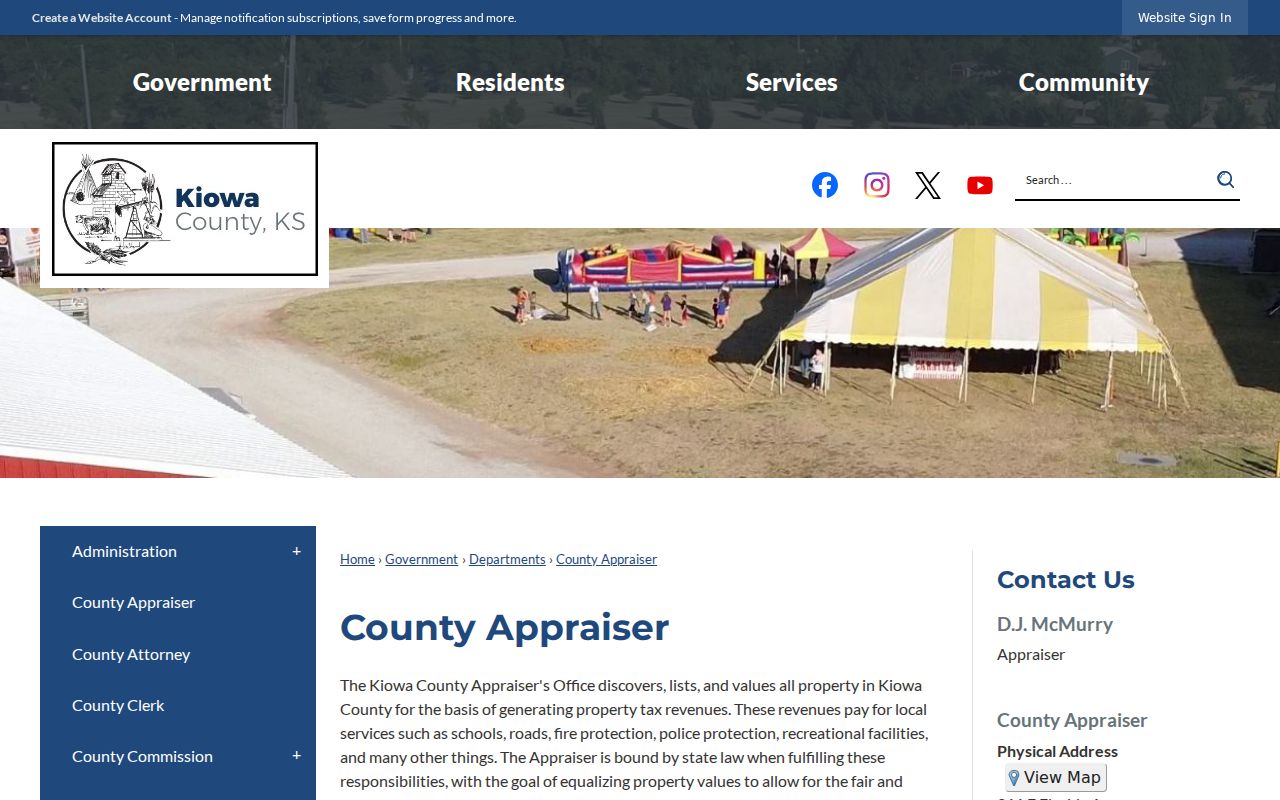
That page shows the office workflow. A parcel-specific value still has to come from the notice or an identified record request.
Last Sale Price Does Not Set Kiowa County Property Value
The Register of Deeds requires a Kansas Real Estate Sales Validation Questionnaire with many deeds unless a statutory exemption is typed on the deed itself. That questionnaire is confidential. It is retained for five years. No official Kiowa County source promises a searchable public sale-price field, so the deed records remain the place to look.
Inspect the recorded deed for any public consideration language. Do not infer a price from the private questionnaire. A transfer may also be a gift, trust transfer, divorce settlement, sheriff deed, corrective instrument, or another exempt event that never behaves like an arm's-length sale. One transaction is a market clue, not the whole mass-appraisal method behind an assessment.
Request a Kiowa County Property Value Record
The KDOR Central Repository/CAMA page for Kiowa County sits behind a User ID and password gate. The county publishes no open parcel card there for the public. Ask the office for the parcel record instead of assuming a free value lookup exists online.
- Gather the situs address, parcel number, owner spelling, and tax year.
- Call the Appraiser at 620-723-3301 or visit 211 E Florida Avenue during published weekday hours.
- Ask for the existing value-detail record and specify appraised, assessed, land, improvement, class, and prior-year fields.
- Record the value year and effective date supplied by the office.
- Inspect a recorded deed separately when a public transaction amount is relevant.
Phone, fax, mail, an in-person visit, or a focused Kansas Open Records Act request will each reach the parcel record. Ask for the existing document by parcel number, not a fresh market estimate. The office will not build a custom comparison on request.
Annual Notices Preserve Kiowa County Value History
Kiowa County's Appraiser mails real-property notices in early March. Each notice lists the current valuation plus the prior year's history. That mailing also opens the local review window. When the online property record card is unavailable, this notice is often the most direct evidence you can hold. Keep the notice itself and its mailing date together. A number that looks off deserves a second look. Start by checking the property description for errors. Then build your case: an appraisal, a sales contract, a survey, repair estimates, photographs, or comparable sales all work as support. That evidence carries weight at an informal hearing. The tax-bill mechanics and the full appeal route are covered with the Kiowa County property tax records, while this page stays on how to read the value itself.
The Kiowa County CAMA Gate Limits Online Comparison
Kiowa County's CAMA gate stops public comparison before it starts. The login screen exposes only User ID, password, and Log In fields, with no owner, address, parcel, or value query for visitors. The KDOR guide shows a Kiowa address-format example and some security context, but it grants no public access and does not publish the local card's current field labels. Any value research log should record that gap plainly.
| Desired field | Online status found | Fallback |
|---|---|---|
| Appraised and assessed values | No public card inspected | Appraiser review or record request |
| Land and improvement split | Target field, not verified online | Ask for the existing detail record |
| Prior-year history | Confirmed on annual notice | Use the mailed notice |
| Public sale amount | No county search field verified | Inspect the recorded deed |
Know the Limits of a Kiowa County Property Value
The Appraiser's figure exists for taxation and equalization across Kiowa County. It is not a promised selling price. Nor is it an offer or a boundary survey. It is not an individual appraisal prepared for a transaction. Its strength is consistency within the assessment system. Its limits show up the moment a property record is asked to answer a different question.
Value is not price. Kiowa County assessed value is a tax figure, not what the property will sell for. Obtain an independent licensed appraisal for a transaction-specific opinion.