
Trace Kiowa County Owners Backward
Start with the present vesting instrument. Then work backward from grantee to grantor. The Kiowa County Register of Deeds holds the recorded title instruments, and Kansas Historical Society collections add older context for early transfers. The county states no online cutoff date, so ask the custodian how far the records reach rather than guessing.
| Transfer Date | Grantor to Grantee | Deed Type | Book/Page |
|---|---|---|---|
| Newest first | Prior owner to present grantee | As stated on instrument | Record exact locator |
| Next earlier | Earlier owner to prior owner | Warranty, quitclaim, estate, sheriff, or other stated type | Match land description |
| Repeat | Each grantor searched as an earlier grantee | Do not assume transfer type | Preserve book/page or instrument number |
| Historic bridge | Atlas or tract-book name as a lead | Historical context, not a deed | Confirm at the Register |
Treat the table as a working timeline. It makes no claim about any real owner. Fill each row only from an inspected deed. A run of names without matching legal descriptions can quietly jump to another parcel, or to a different person who happens to share the name.
Start With Kiowa County's Vesting Deed
Ask the Kiowa County Register of Deeds for the most recent deed matching the parcel's legal description. Treat the Appraiser's current owner name as a lead. Request the recording date too. Include the book and page, or the instrument number, so the locator anchors every later step.
The Register records deeds, mortgages, plats, leases, liens, releases, assignments, and other instruments, but it is a recorder, not a research service. So narrow requests work best. Give both name spellings, an approximate date range, and the complete land description. The official Register of Deeds source confirms this route.
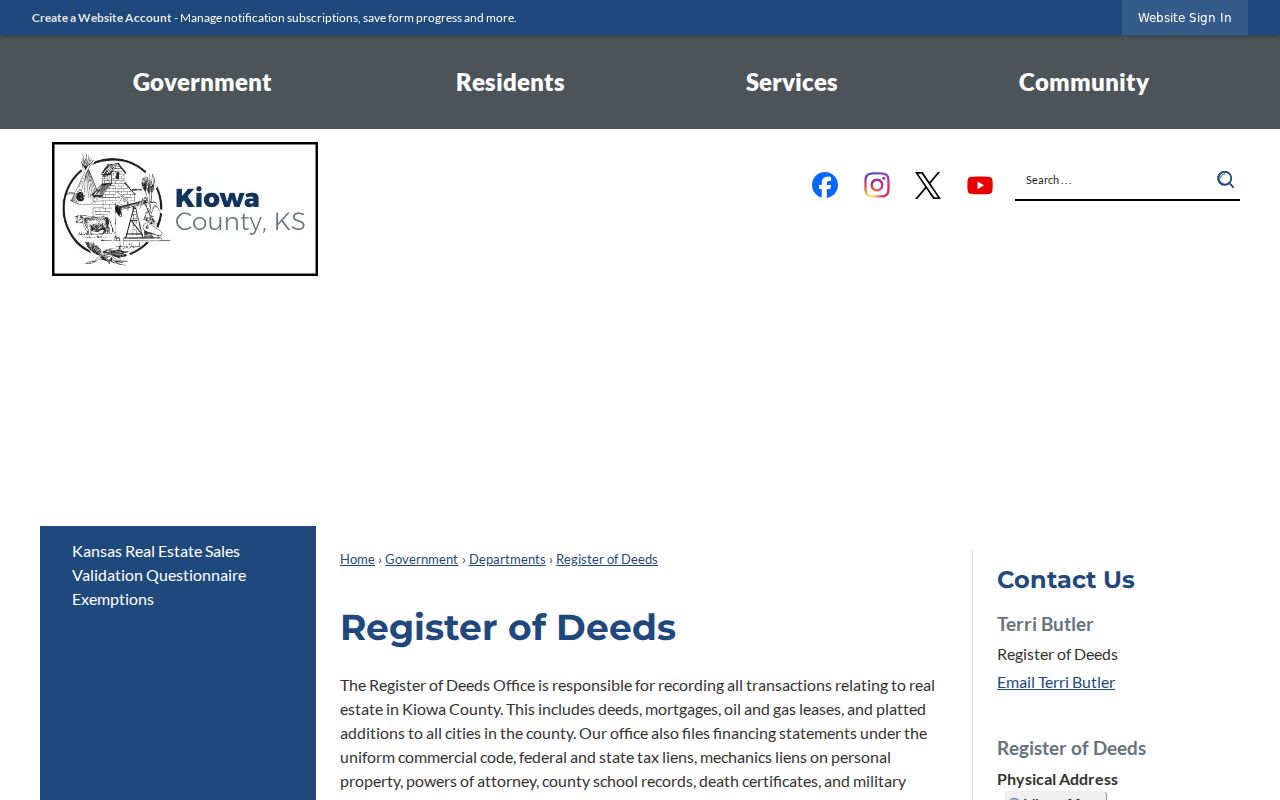
The Register of Deeds page lists the copy options that support a records request. Ordinary copies run $1 per page. Faxed copies cost $2 per page, and certified instruments are $13, so confirm current prices before ordering. The sales-validation questionnaire is confidential.
Reconstruct Kiowa County's Deed Chain
Former owners emerge by reversing the transfer direction. The current deed names the grantor who conveyed the property; search that grantor as a grantee on an earlier acquisition, then repeat the pattern deed by deed.
- Find the present owner's vesting deed and record its date, grantee, legal description, and locator.
- Copy the grantor name exactly. That party is the immediate former owner shown by the instrument.
- Search the grantor as a grantee in an earlier date range. Confirm the same land description.
- Repeat the process. When index access ends, ask for physical or filmed deed books and reverse indexes.
- Grantor
- The party conveying the stated interest.
- Grantee
- The party receiving the stated interest.
- Chain of title
- The ordered sequence of instruments affecting title.
- Reverse index
- An index organized to help trace parties from a known name into earlier records.
- Quitclaim and warranty deeds
- Different deed forms with different promises; neither label alone proves a complete chain.
Match Kiowa County Land Descriptions
Names alone prove nothing. City land in Kiowa County is described by lot, block, and addition. Rural parcels use section, township, range, and quarter parts. Preserve every “less,” “except,” easement, acreage, or replat reference, because a split or combination can change the parcel number while an older deed keeps the prior description.
The 2025 tax-sale notice offers a handy form example. Kemp's Second Addition to Haviland appears there with lots and block. Five-digit parcel numbers keep their leading zeroes. Those fields help frame a Register request, but a tax-sale entry proves neither the current owner nor the balance.
Historic place names add another trap. Wellsford, Belvidere, Dowell, Greensburgh, and Janes all surface in older sources, so use the legal description to tie an old label to a current Kiowa County parcel.
Kiowa County's 1906 Owner Snapshot
The 1906 Standard Atlas of Kiowa County is a gold mine. It holds 53 scanned pages. Township maps, town plats, landowner labels, directory material, and portraits fill them. Greensburg spans north and south sheets. Haviland shares one sheet with Wellsford and Belvidere. Mullinville shows its rail, cemetery, avenues, and grid.
For former owners, this atlas ranks among the strongest local clues. It is still only a snapshot. Use the atlas name, lot grid, and township location to pinpoint the likely deed-book search. Never place an atlas owner into a title chain. Wait for a recorded instrument that confirms the link.
Bridge Early Kiowa County Ownership
Kansas Historical Society tract books track federal land entries by township, range, section, and part. Each entry may list the purchaser, acreage, price per acre, total, sale date, and governing law. The books are indexed by description. Purchaser names will not get you in.
Treat the tract entry as the first-transfer lead. Then connect it to county deeds. Kiowa County publishes no earliest deed-book date and no microfilm cutoff, so ask the Register and KSHS which physical index, book, or film continues the chain. No courthouse fire haunts Kiowa County records. Do not invent a gap.
A tract-book entry, patent lead, or historic atlas cannot replace the intervening conveyances; it adds time depth while the Register's instrument trail remains the true ownership record.
Corroborate Kiowa County's Prior Owners
The KSHS newspaper database searches by place, title, county, state, and date. Early Kiowa papers include the Greensburg Rustler, the Wellsford Register, the Democrat, and the Watchman. Legal notices are the real treasure. Estates, sheriff sales, petitions, construction, vacations, and annexations all surface there.
A notice corroborates a date or event. It never replaces the resulting deed, judgment, or plat. Search the owner surname, old and current place names, and lot and block terms. Keep the date range tight. The document named in the notice then continues the chain.
Explain Kiowa County Chain Breaks
A tidy buyer-to-seller run of Kiowa County property records can break apart in several ways. An estate transfer can do it. So can a court order, sheriff deed, tax foreclosure, trust change, or entity conveyance. The District Court portal offers public case information. Some documents and case types still require a courthouse visit. Any judgment, lis pendens, or sheriff deed in the chain deserves a cross-check against the Register of Deeds. There the deed records control.
An LLC lookup through the Kansas Secretary of State proves legal identity and status. It says nothing about title. A death certificate is restricted, so it is not a public parcel tool. In estate work, the probate docket answers one piece of the transfer. The recorded representative instrument answers another.
Keep tense honest. These sources show how earlier interests in a parcel moved. Today's owner of record lives in the latest assessment roll and the most recent deed.
Log Kiowa County Prior Owners
Give every transfer its own row and never skip an unexplained interval. Log the execution date, recording date, grantor, grantee, deed type, legal description, book or page and instrument number. Log the source copy too. The date signed is not the date recorded. Keep them separate. When the chain runs through a trust, estate, court, or sheriff, note the supporting case or authority beside the deed entry. Do not replace the deed entry with it.
Name variants earn a field of their own. Initials, married names, and entity suffixes can hide earlier results in the deed records. So can spelling shifts. Search each prior owner as both grantor and grantee across a narrow window first. Widen it only if needed. A legal-description mismatch is a stop sign in any Kiowa County property search. That holds even when the names and street address look right.
Kiowa County's Record Timeline
Kiowa County was organized in 1886. Greensburg dates to that same year. Haviland's town company formed in 1886 before later incorporation. Mullinville had been staked in 1884. Those dates mark when municipal and county sources become plausible. They do not establish the first deed-book date in the county's property records.
No courthouse fire, flood, or destroyed deed book appears in the record for Kiowa County. No WPA index or restoration project appears either. Treat that absence as a gap, not a finding. Ask the Register of Deeds or the Kansas Historical Society about book gaps or reconstructed indexes. Do that before concluding a missing transfer was never recorded.
How Far Back Kiowa County Records Reach
Kiowa County was organized in 1886. The 1906 atlas and federal tract books reach back well before modern digital access. The earliest county deed-book date, index cutoff, microfilm coverage, and digital imaging year are not published, though. Ask the Register of Deeds which book or reverse index begins the physical chain of deed records.
A request should name the property and a known owner. It should also give the legal description and the target years. Ask whether inspection happens at the courthouse. Ask whether older volumes sit on film, and what copy fees apply. If a routine request stalls, request the existing index or instrument under the Kansas Open Records Act. Do not ask for a new history report on the parcel.
Unknown cutoff. No official online start year was found. Older owners may require physical deed books, reverse indexes, KSHS tract books, and archived newspapers.
Former-owner research in Kiowa County property records supports house history, estate work, and purchase diligence. It must never be used to stalk, harass, or harm a living person. For a single certified deed rather than the full backward chain, use the Kiowa County deed search process.